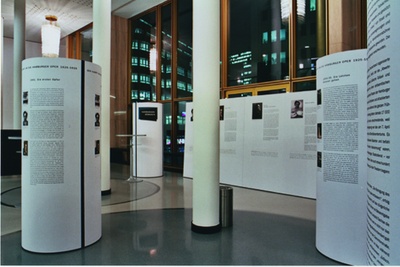
In 2006, the historian Hannes Heer, the designer Peter Schmidt (†2025) and the music journalist Jürgen Kesting (†2026) mounted an exhibition project at the Hamburg State Opera that was unprecedented at the time. Entitled “Verstummte Stimmen. Die Vertreibung der ‚Juden‘ aus der Oper 1933–1945” (Silenced Voices. The Expulsion of ‘Jews’ from Opera, 1933–1945), it examined the National Socialist seizure of power at a site of bourgeois high culture and brought into public view the names and life stories of those who had fallen victim to the persecution that began in 1933: artistic directors and dramaturgs, singers, actors, members of the chorus and orchestra, and technical and administrative staff.
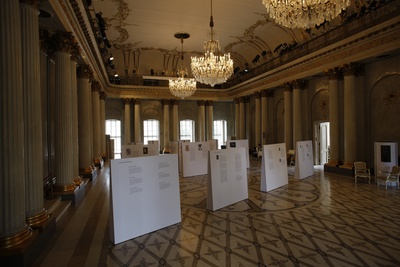
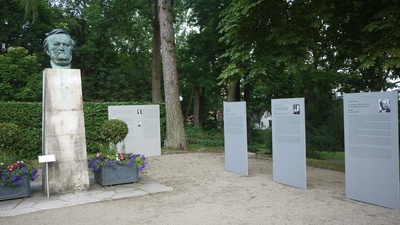
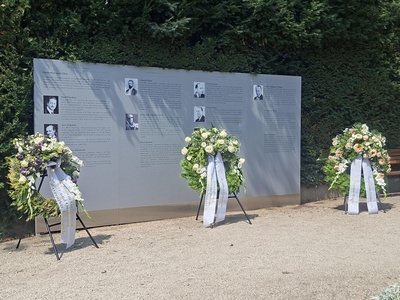
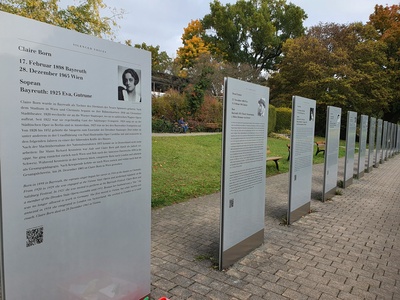
The exhibition’s success prompted a veritable flood of enquiries from across the Federal Republic of Germany, turning the Hamburg project into a touring exhibition. Under the curatorial direction of Hannes Heer, it travelled to Berlin’s Staatsoper Unter den Linden in 2007, the Staatstheater Stuttgart in 2008, the Staatstheater Darmstadt a year later, and the Semperoper and Staatsschauspiel Dresden in 2011. In 2012, the exhibition reached its final destination in Bayreuth, where it has since remained on view as an extensive open-air installation on the “Green Hill” of the Richard Wagner Festival.
The extensive research in German and international archives required to investigate the histories of the various institutions was consistently guided by two closely interconnected sets of questions. The first concerned the reconstruction of the background to, and the specific course of, the expulsions of Jewish and politically unwelcome members of these institutions that began after the seizure of power; the second sought to reconstruct the victims’ fates in as much detail as possible. Specifically, this meant: 1. investigating the precise chronology of the seizure of power at the opera houses and the subsequent sweeping purges of their staff; 2. identifying the local, regional, institutional, political and social structures involved; and 3. identifying the perpetrators’ networks necessary for an intervention on such a massive scale. Above all, however, it concerned 4. the effects of the expulsions on the victims’ lives: How had they responded to dismissal, professional bans and unemployment? Had they succeeded in escaping into exile, and had they been able to build new lives there? Had they attempted to survive Nazi rule and the war in Germany or occupied Europe, or had they been deported to ghettos and concentration camps and murdered?
Over the course of approximately seven years of research, it proved possible to bring some 270 of these individual fates to light and to secure the victims a place in public remembrance at the institutions where they had once worked. Many of these victims, often rescued from oblivion for the first time, were not prominent figures but part of the backbone of every opera house and theatre: stage technicians and theatre doctors, chorus singers and orchestral musicians, dramaturgs, accountants and wardrobe attendants. Their life stories, presented in the form of scholarly short biographies, formed the core of the exhibition.
This belated recognition carried particular weight wherever comfortable post-war narratives had obscured historical realities with remarkable force. In the case of the opera houses in Darmstadt and Dresden, for example, it was possible to demonstrate that the seizure of power at these institutions had by no means been brought about solely by external pressure, but had instead taken place from within—with the assistance of Nazi cells that had existed within the ensembles long before. Nor, contrary to what had been suggested in the literature for decades, had the “purges” at German theatres proceeded any more slowly, cautiously or even “considerately” than at other institutions. Finally, accounts of spectacular acts of assistance and rescue often proved to be retrospectively constructed narratives of downplaying, concealment and exoneration. The challenges to established perceptions arising from the exhibition prompted a wide range of debates and lasting changes in the cultures of remembrance at the respective locations, the effects of which continue to be felt twenty years after the exhibition project began.
The research findings were presented to a broad public not only through the exhibition itself but also in exhibition catalogues. These were supplemented by scholarly conferences and publications that took the exhibition’s concept as their starting point and extended their focus to other locations. For example, an edited volume published in 2011 on the expulsions at theatres in Hesse documented the histories of the respective institutions in Frankfurt am Main, Wiesbaden, Kassel, Mainz and Gießen. In 2013, a further volume appeared to an extremely positive reception among scholars and the public alike. It brought together contributions by distinguished historians and musicologists who, at a conference held to mark the opening of the exhibition in Bayreuth, had discussed the subject of “The Bayreuth Festival and the ‘Jews’, 1876–1945”.
“After all, we want to leave the Jews out.” Hannes Heer used this quotation as the title of his contribution to the catalogue for the Bayreuth presentation of “Verstummte Stimmen” (Silenced Voices). The remark comes from a letter written in 1888 by the conductor Felix Mottl to Cosima Wagner, Richard Wagner’s widow, who, following her husband’s death in 1883, had become the head of the family dynasty and director of the family enterprise, the Bayreuth Festival. She and the letter’s author shared a long-standing working relationship and a close friendship: Mottl was one of her closest associates in the festival’s senior leadership, conducted numerous performances at the Festspielhaus himself and was also the teacher of Cosima’s son Siegfried, who was intended to become the future head of the family.
“Leave the Jews out”—in its stark simplicity, but above all in its casualness, Mottl’s remark demonstrates one thing in particular: the normality with which antisemitism, already in the nineteenth century, not only formed part of the bourgeois worldview but could also become a guiding principle of everyday conduct.
During our research for the Bayreuth exhibition, it was less this fundamental finding that surprised us than the radicalism and determination with which the Wagner family and its surrounding circle of advisers had consciously and deliberately made their racist and antisemitic convictions the basis of a “company policy” that would remain in force for decades. Under such leadership, the “company”—the Bayreuth Festival—had, by the late nineteenth century, become a medium and a cult site for the dissemination of a worldview that, through a process of increasing radicalisation, merged, not inevitably but logically, into National Socialist ideology. As already mentioned, this previously largely overlooked part of the history of the Bayreuth Festival and the Wagner family is the subject of the exhibition that has been on view in the festival park since 2012.
Responsibility for this exceptional installation has since rested with the City of Bayreuth, which has, for which we are grateful, also assumed responsibility for this website. In doing so, it enables not only the digital preservation of the accumulated knowledge but also, and above all, the continuation of the project in a digital space of remembrance: the findings of the research into the individual exhibition locations are brought together here, interconnected and presented to a broad public in a contemporary form. The multi-perspective approach—the biographies of those persecuted can be accessed both by individual and by location—makes it possible to render overlaps in life trajectories, personal networks, and structural similarities or differences in experiences of persecution clearly visible and comprehensible in a lasting way.
At the same time, the physical and digital sites of remembrance remain connected: the stelae in Bayreuth’s festival park feature QR codes that link directly to the respective biography on the “Verstummte Stimmen” (Silenced Voices) portal. The theatres participating in the digital project—the Hamburg State Opera, Berlin’s Staatsoper Unter den Linden, the Sächsische Staatstheater Dresden and the Staatstheater Stuttgart—have also found ways to direct people to the portal within their institutions, thereby establishing a lasting bridge of remembrance to those expelled from them. Particularly impressive in this context was the support for the project shown by the artists and staff currently working at the institutions in Berlin, Hamburg, Dresden and Stuttgart, who gave their time, empathy and voices to record readings of the biographies of the victims of expulsion. The commitment that emerged in the process was overwhelming, demonstrating both the desire and the need for authentic, lived remembrance at the actual site—both physically and digitally.
Hamburg, July 2026 Sven Fritz & Jens Geiger-Kiran
Konzept, Texte und Gestaltung: Hannes Heer, Jürgen Kesting, Peter Schmidt
Projektleitung: Hannes Heer, Jens Hommel
Text und Recherche: Hannes Heer, Sven Fritz, Jens Geiger, Boris von Haken, Eckart Dietzfelbinger
Mitarbeit Recherche: Peter Behr, Marco Kühnert, Anna Schifer
Übersetzung: Matthew Partridge
Bildbeschaffung: Alexandra Böhm
Gestaltung: Peter Schmidt
Gestalterische Abwicklung: Peter Schmidt Group
Produktion: Schildertechnik Paschold GmbH, Kulmbach
Bauvorbereitungen: Stadtbauhof Bayreuth
Veranstalter:
Stadt Bayreuth, Richard-Wagner-Stiftung
Verantwortlich: Carsten Hillgruber
Koordination: Dr. Sven Friedrich
Ausstellungskatalog und weitere Publikationen unter: https://metropol-verlag.de/
Konzept, Texte und Gestaltung: Hannes Heer, Jürgen Kesting, Peter Schmidt
Projektleitung: Hannes Heer, Jens Hommel (Co-Leiter)
Mitarbeit Organisation: Jens Geiger
Texte und Recherche: Hannes Heer, Sven Fritz
Mitarbeit Recherche: Thomas Fache, Kathryn Babeck
Bildbeschaffung: Alexandra Böhm
Gestaltung und Abwicklung: Oliver Schulze - Peter Schmidt Group
Technische Leitung: Henning Best
Produktion: Ernst Deutsch Theater
Veranstalter:
Semperoper Dresden, verantwortlich: Dr. Ulrike Hessler, Organisation: Doris Schneider
Staatsschauspiel Dresden, verantwortlich: Wilfried Schulz
Ausstellungskatalog und weitere Publikationen unter: https://metropol-verlag.de/
Konzept, Texte und Gestaltung: Hannes Heer, Jürgen Kesting, Peter Schmidt
Projektleitung: Hannes Heer
Mitarbeit Projektleitung: Jens Hommel
Mitarbeit Organisation: Jens Geiger
Texte und Recherche: Hannes Heer
Mitarbeit Texte: Sven Fritz
Mitarbeit Recherche: Sven Fritz, Peter Behr
Bildbeschaffung: Alexandra Böhm
Gestaltung und Abwicklung: Oliver Schulze- Peter Schmidt Group
Technische Leitung: Henning Best
Produktion: Ernst Deutsch Theater
Veranstalter:
Staatstheater Darmstadt, verantwortlich: Intendant John Dew
Hessisches Staatsarchiv Darmstadt, verantwortlich: Ltd. Archivdirektor Prof. Dr. Friedrich Battenberg
Ausstellungskatalog und weitere Publikationen unter: https://metropol-verlag.de/
Konzept, Texte und Gestaltung: Hannes Heer, Jürgen Kesting, Peter Schmidt
Projektleitung: Hannes Heer
Texte und Recherche: Hannes Heer
Mitarbeit Texte und Recherche: Sven Fritz, Till Reininghaus
Mitarbeit Organisation: Jens Geiger
Bildbeschaffung: Alexandra Böhm
Gestaltung und Abwicklung: Oliver Schulze – Peter Schmidt Group
Technische Leitung: Henning Best
Produktion: Ernst Deutsch Theater
Veranstalter:
Staatsoper Stuttgart, verantwortlich: Albrecht Puhlmann
Organisation: Sergio Morabito
Haus der Geschichte Baden-Württemberg
Verantwortlich: Dr. Paula Lutum-Lenger
Organisation: Oliver Fuchs
Film: Thomas Eilenstein, Dr. Immo Wagner-Douglas
Ausstellungskatalog und weitere Publikationen unter: https://metropol-verlag.de/
Konzept, Texte und Gestaltung: Hannes Heer, Jürgen Kesting, Peter Schmidt
Projektleitung: Hannes Heer
Texte/Recherche: Hannes Heer
Mitarbeit Texte/Recherche: Eva Maria Maschke, Sven Fritz
Mitarbeit Organisation: Stefanie Wahl
Bildbeschaffung: Alexandra Böhm
Gestaltung/Abwicklung: Florian Schmitt – Peter Schmidt Group
Technische Leitung: Raik Eberhardt
Produktion Ernst Deutsch Theater
Veranstalter:
Staatsoper Unter den Linden Berlin, verantwortlich: Francis Hüsers
Organisation: Ilse Ungeheuer
Stiftung Neue Synagoge Berlin – Centrum Judaicum, verantwortlich: Dr. Hermann Simon
Organisation: Dr. Chana Schütz
Gegen Vergessen – Für Demokratie e.V., verantwortlich: Dr. Andreas Eberhardt
Organisation: Dr. Dennis Riffel
Ausstellungskatalog und weitere Publikationen unter: https://metropol-verlag.de/